Wednesday, December 1, 2010

Mule Deer

Basically there are three species of Deer in North America, Mule Deer, Whitetail Deer, and the Blacktail Deer. The Mule Deer can easily be identified by the black tip on the tail with the underside of the tail being white. The Whitetail Deer will have no black and the entire underside is comprised of white hair. Typical of them, when they run, their they stick their tail straight up in the air as a flag. The Blacktail Deer is the smallest of the deer family and will have black hair on the underside of the tail. As in most of the deer family, the males will form horns, dependent on it's age. The females or does will remain anterless. The Whitetail Buck will normally have larger antlers in circumference and they will have a wider spread. The Mule Deer Buck will typically have smaller diameter horns but they will spread and grow higher than those of the Whitetail.
I was somewhat concerned about finding a large Mule Deer Buck, I feel very fortunate to have seen several which I would classify as trophy type animals. The Mule Deer can be found throughout the western United States and some areas in Canada. In some states, the population has diminished over the past few years due to a disease inherent to the Mule Deer. However, I was fortunate to see a good number, much better than I had expected. The name of the Mule Deer is derived from it's ears, larger than the others in the deer family. Their hearing is very keen and will spook easily by an unfamiliar sound.
Mule Deer Buck ~ Missouri Breaks, North Dakota
Mule Deer Buck ~ Toad River, British Columbia, Canada
Mule Deer Doe and Fawn ~ National Bison Range, Montana
Mule Deer Doe and Twin Fawns ~ Badlands, North Dakota
Mule Deer Doe and Twin Fawns ~ Roosevelt National Park, North Dakota

Friday, November 26, 2010

The "Bear"

During the year of 2010, I had the opportunity to photograph three species of those bears that inhabit North America. The Black Bear, Brown Bear, and Grizzly Bear. I would love to photograph the remaining specie, the Polar Bear, however, to accomplish that task I would need to fly to the western and northern coast of Alaska. My primary objective was to photograph those species that can be obtained from our normal highway system. There is one, possibly two sub species of these bears that are found in southeast Alaska and western Canada. They would include the Cinnamon Bear and a nearly white bear that is known as the "Spirit Bear" in western Canada. This particular specie of bear could also be a sub-specie of the Brown or Grizzly Bear.
Black Bear Boar ~ Buffalo Bill State Park ~ Wyoming
Grizzly Sow ~ Shoshone River Valley ~ Wyoming
Grizzly Sow And Cub ~ Shoshone River Valley ~ Wyoming
Brown Bear ~ Hallo Bay, Alaska

Friday, November 19, 2010

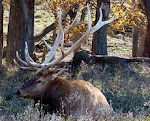
Elk

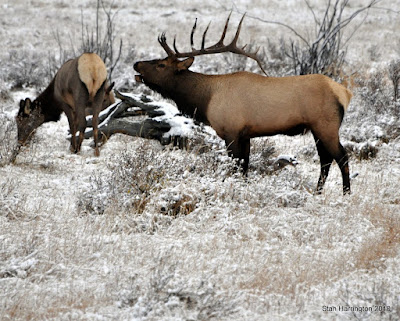
Although, all of our antlered wildlife are beautiful animals and unique in their own way. I have a special fondness for the Elk. They are such a regal animal, their size and antler structure marks them as the monarch of their habitat area. It is amazing how gracefully they can move through heavy timber, despite the size of their antlers. In my travels this fall, I can happily report that our Elk population is very strong throughout the western states. I saw Elk in the Yukon Territory, British Columbia, Alberta, Idaho, Montana, North Dakota, South Dakota, Wyoming, Colorado, and Arizona. The biologists maintain that there are two species of Elk, the Mountain Elk and the Prairie Elk. Although, I could not tell the difference unless it was in the horn structure and body weight. In South Dakota, I had perhaps a once in a lifetime opportunity when I had the chance to see seventeen Bull Elk in a large meadow. Several other Bull Elk were already moving into the heavy timber which I did not count. I would estimate that there were at least twenty-five Bull Elk herded up. Their size ranged from spikes to large "Royals". There was not a single cow of calf in the area. While watching them, hoping for better photography light, I had the chance to see several of the bulls sparring with one another. The night prior to seeing them, I had siwashed out and could hear their bugling throughout the night. Like themselves, their "bugle call" is distinct and a sound that you never tire of hearing.
~ Colorado ~
First snow of the season, the Bull in the next two pictures had a herd of nine cows and one "Spike Bull" that kept getting chased away by the herd Bull.
"Bugling Bull"
JASPER NATIONAL PARK ~ CANADA This particular "Royal" had a herd of eleven cows with him and provided me a couple of hours of entertainment in photographing him and his herd.
~ MONTANA ~
This monster Bull Elk was perhaps the largest Bull that I saw on my trip. The "rut" had not yet started and he was traveling with three smaller Bulls.
Black Hills ~ South Dakota
This "Royal" was considering the rut, although he was "bugling", he was conserving his energy for any bulls that wanted to challenge him as well as resting up for the rut.

Tuesday, November 9, 2010

The "Grand Slam"

For many years in the big game hunting circles, the ultimate goal for many hunters was to get a "Grand Slam". For the record books, the "Grand Slam" consisted of shooting one of each of the four species of wild sheep in North America in a one year period. This "Grand Slam" would include the Rocky Mountain Big Horn Ram, Desert Big Horn Ram, Stone (Stone's) Ram, and the Dall Ram.
This particular goal is very difficult to achieve today due to more restrictive hunting regulations and very limited permits. Occasionally special permits are issued for a particular specie and used as raffle or auction item in raising funding for wild sheep habitat and other projects. Today, to obtain a "tag" or special permit to hunt a specific breed, you can expect to spend multiple thousands of dollars just for a permit. The true "Grand Slam" is now history for hunters. I have not heard of one being achieved in a number of years.
However, with a camera you can still achieve a "Grand Slam" which was one of my ultimate goals for 2010.
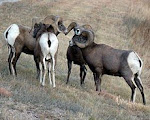
Although, getting "close up" shots without the use of a telephoto lens is difficult, I feel very fortunate to get three out of the four of my rams with little or no telephoto. I found the Desert Ram the most difficult to achieve when you are on their home turf. I also feel fortunate to have been at the right place at the right time. Each of the species of rams will "hang out" together prior to and following the annual rut. I was able to observe and photograph a "Gang of Nine" Mountain Big Horn Rams in the Black Hills of South Dakota and a "Gang of Six" Desert Big Horn Rams in Nevada.
I am not a biologist nor an expert in regards to wild sheep. However, the Desert and Rocky Mountain Big Horn sheep are related. The Rocky Mountain Big Horn has more body weight and larger in size than the Desert Big Horn. However, the horns of the Desert Ram are larger and has a slightly different curl than that of the Rocky Mountain Big Horn. At times, the horns of the Desert Big Horn appear to be out of proportion to their body size.
"Gang Of Six"
Desert Big Horn Rams ~ Area of Beatty, Nevada
Desert Big Horn Ram ~ Area of Beatty, Nevada

Rocky Mountain Big Horn Ram ~ Black Hills, South Dakota

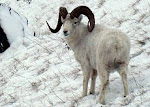
The Stone Sheep and the Dall Sheep are also related according to my research. Each of them similar in size and horn curl similar. The primary difference is their coloration, each of them taking on the camouflage color of the background of the area in which they live. Both species live at the higher altitudes during the summer, moving down the slopes as the winter snow accumulates and covers their feeding areas. The Dall Sheep can be found throughout Alaska and northern Yukon Territory. The Stone or Stone's sheep is found in the Yukon Territory and occasionally in northern British Columbia. Dall Ram ~ Turnagain Arm, Alaska Stone Ram ~ Toad River Area, Yukon Territory

Monday, November 8, 2010

Natural Camouflage

Mother Nature is still the best when it comes to camouflage art and the protection of her animals. The three pictures below demonstrates her abilities. How many Rocky Mountain Big Horn Sheep do you count in the below picture?
Flock Of Big Horn Sheep at Thompson Falls, Montana

Desert Big Horn Ram ~ Area Of Beatty, Nevada

A Very Nice Buck Mule Deer In this Picture
(Wyoming)
There are times that even the majestic Bull Elk does not want to have their picture taken. (South Dakota ~ Black Hills)