Friday, February 17, 2012

Winter Moose Range

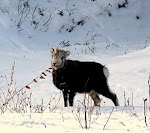
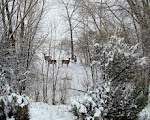
The Anchor River Valley below our home is a traditional "Winter Moose Range", although in the past I have seen twenty to thirty Moose in a one mile section from the highway to the beach, this year we are once again seeing a smaller winter population. At the present time we have a dozen Cows, Calves, and some young immature Bulls in this area which is about all that it will currently support. Today, I was fortunate to have five Moose in close proximity of one another. A Cow which was feeding and this young Bull that decided it was time to take a afternoon nap. Unknown to him, but in a few short weeks his mother is going to kick him out of the nest. Chances are that she is pregnant and will be calving this spring. Prior to calving, she will abandon him to be on his own. In a couple of months, he will discover that he is no longer with his mother but he will also experience the growth of single "spike horns" sprouting from his forehead. The transition of mother / calf separation is evident. She was a hundred yards away from him feeding, when he decided to take a nap. Although, I was within feet of him, she paid me no attention.
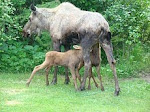
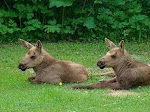
The exact opposite was evident with the other three Moose in the area, a Cow and two Calves. They had also bedded down, but her calves were a year younger than the single Bull Calf. She kept her babies close to her, nestled against her to give them her body warmth. Although, she did not disturb her napping calves, she was very aware of my presence by keeping her eyes glued on me and flicking her ears. I gave her a wide berth so as not to disturb them, plus I cannot run as fast as she could if she decided that I was within her safety zone. Once again, a great opportunity to just witness and make attempt to figure out what was transpiring in their lives.
How many Moose do you see in this picture? If you count the ears, there are three Moose. This cow and two calves have bedded down for the afternoon, the one Calf behind the Cow never showed it's head. It was perfectly comfortable cuddled up against his /her mommy. The Calf in front of the Cow is also a young Bull Calf, his nubbins will grow a little this spring and summer but will not sprout as full spikes until next year. 
  
"Alder Patch Bed" 

First time that I have had the opportunity to shoot the full process of a Moose laying down, although they appear to be clumsy in the process, on their feet they are much faster and agile than their awkward appearance would indicate.

"Time For A Good Afternoon Nap"


Thursday, February 16, 2012

Traveling Buddy

"DUTCH"
Today, while I was out and about looking for subjects to photographed, I stopped by the beach area of Anchor Point to allow my traveling buddy a little time to play. He loves the beach and with the snow pack frozen, he was able to explore some new spots. While watching him, I realized that I very seldom photograph him when we travel.
For those that are not familiar with his breed, he is an AKC Registered Nova Scotia Duck Tolling Retriever. He will turn ten in March of this year. He was born at the Dutch Harbor Kennel in Dutch Harbor, Alaska. His Sire is Redventure's Artful Dodger and his Dam was Nibiru's Molly. His registered name with the American Kennel Club is Dutch Harbor Dutchman, but we just call him "Dutch".
He has put on a lot of miles with me, in the past two years we have logged 35 - 40,000 miles including two round trips over the Alcan Highway, three Canadian Provinces, and fifthteen states.  We have had some great adventures and there will be more as we travel together. 
"Temperature A Little Nippy On the Nose"


"Hard Pack Snow Provides A Good Back Scratch"


"Keeping An Eye On Me"


"Picking Up A Scent"


"Exploring the Scent"


"Windy Day"


 "Time to Travel"


Saturday, January 21, 2012

Winter Moose Range

With the high pressure system that has dominated the majority of Alaska for the past week, we have been having some beautiful clear days which create some beautiful sunrises and sunsets.  The clear days and nights have also brought on some colder temperatures than we normally see.  This is sunrise on Mt. Illiamna, a volcano that is located across Cook Inlet from Anchor Point, Alaska.  The date is January 21, 2012  and the current temperature when this shot was taken was -22 degrees. The ice fog is created from the marine waters of Cook Inlet being warmer than the air temperature.  The entire surface of Cook Inlet was blanketed by this fog. 

"Mt. Illiamna and Cook Inlet"


This calf was born last spring, with the calf bedded down, the Cow Moose has wandered a short distance away to feed, however, keeping a watchful eye on me.  For the most part, the calves have been weaned and are now on their own to grub for their own food.

"Nap Time"
 

I was closer to the Calf than the Cow, so she naturally kept an eye on me to insure that I did not encroach to close.  Not to disturb either of them, I used a touch of telephoto to focus in on the calf while at the same time keeping a watchful eye on the Cow.  Typically, if they are getting agitated at your presence, they will warn you with a deep grunt or flexing the ears.  If the ears are laid back flat and the hair on their back rises, then it is time to back out and leave them alone.  In the picture below, she is not concerned about me, but still tracking me to in sure I do not encroach to far. 

"Mom Is Watching"

To see how she would react, I moved around a tree out of her sight, still maintaining a safe distance.  She only took a couple of steps to stand behind a large Cottonwood Tree where she could still watch my location and movement.  At this point, I am taking shots of her with my normal lens with no zoom.  Her ears are flexing slightly, but primarily to kick up my sound. 

 "The Trees Have Eyes"

I moved around the tree a little more and out of her sight, when I could view her again, she was in the  same spot but had her head wrapped around the tree to spot me without herself moving.  As she and I were playing our peek-a-boo game, the Calf remained bedded down and not concerned which is likely why the Cow was just watching me and not moving closer to the calf. Once again, it was a very good observing period, but still one where you had to make them feel as if they were dominant and you posed no threat to them or their young.  As a word of warning, do not push them and leave yourself a safety zone, a mad Cow Moose especially one with a Calf can kill you faster than a Brown Bear.  Her front legs are lethal weapons.  Leaving them alone, I retreated to the warmth of my truck to watch them a little longer. The Cow continued to feed and the Calf remained in bed. 

"Peek A Boo Tree"
 

Monday, January 16, 2012

Bull Moose

At daylight, I spent the morning on the Upper Anchor River, continuing my search for Bull Moose.  Temperatures on the Upper anchor River this morning was -23 Degrees.  Although, I consider myself fortunate to view sixteen Moose in about a two hour time span, they were all Cow and Calves.  Returning home, I received a call from friends that had spotted a Bull Moose from their home.  Although, the Bull was in a difficult place to get into due to the deep snows, I was able to get some long distance shots of him from the comforts of the decks of their home. 
The Bull is a young breeder, still having a harem of three cows with him.  The heavy snowfall that we have had this year, has hampered their movement but this particular Bull has chosen a good location to winter with a good supply of willows and other vegetation in the area. To preserve his energy, within days or weeks he will shed his antlers.  Come spring, he will once again start growing a new set, which will increase in size with each passing year.

"Bull and Cow Moose"

"Bull Moose In The Cottonwoods"


(Antler Palms Filled With Snow)
"Feeding On Cottonwoods Branches"

(Enjoying the protection of the Cottonwoods and less snow depths.)

 Tried to imitate a "Moose cough" to get his attention, although he responded by looking around, he never saw me or picked up a scent since I was above him and some distance away.

 Feeding on the tender tips of the Cottonwood Tree limbs.

 A good looking Bull, wish there was a way to see him come early fall after he has shed his velvet to see the increase in size of his antlers

"IT WAS A GOOD DAY"

Monday, January 2, 2012

Happy New Year 2012

January 1, 2012:  What better way to celebrate the New Year than to take a drive around your neighborhood, just to enjoy the diversity and natural beauty of the area in which you live.  I drove a total of thirty one miles round trip, taking a little over two hours to complete the journey.  During my "Photo Trek", I had the fortunate opportunity to view eighteen (18) Moose.  The highlight was having the chance to see three Bull Moose with the remainder being Cows and Calves.  This is the highest Bull to Cow ratio that I have witnessed in recent years. 
My trip started just a mile from my home on the beaches of Cook Inlet in Anchor Point, Alaska.  The temperature was a balmy -9 degrees.  This is the most Westerly Highway Point in North America that is continuously connected by the highway system.  Cook Inlet is named after the famed British Explorer, Captain Cook.  Unusual to see the air temperature low enough in comparison to the salt water temperature to create steam.
   
"Cook Inlet New Year's Day 2012" 


Approximately fourteen miles inland from the beaches of Cook Inlet.  This location is relatively close to where my wife's family homestead in the 1950's.  The valley in the foreground is the Anchor River Valley.  The plateau shape mountain in the background is Ohlson Mountain.  In the 1950's to 1963 this was an active Air Force Base for communications and connected in with the Dew Line and White Alice Sites.  All of which were early warning systems for our National Defense.  Temperature at this location is -14.

"Anchor River Valley and Ohlson Mountain"

From this particular site, you can also see the mountains that border Kachemak Bay which flows into Cook Inlet.  The distance to those mountains is deceiving.  They are approximately 30 - 35 miles in distance from where this photo was taken.  To reach those mountains from this point by cutting across country, you would need to traverse several smaller ridges and valleys as well the Anchor River Valley, Crossman Ridge, and Diamond Ridge; eventually dropping down onto the bench where the City of Homer is located on the north shoreline of Kachemak Bay. From Homer, you would then need to cross Kachemak Bay to reach the lower slopes of this mountain range.  The area in which this picture was taken was homesteaded by hardy families, prior to the construction of any road system.  One of their primary access trails into this area was from Diamond Ridge.  Which is the last tree line ridge you can see in the photo.

"Upper Anchor River Valley"

With a recent heavy snowfall, the Moose are now moving from the higher elevations of the foothills into the lower elevations to winter. These low lying valleys and ridges are their winter habitat areas primarily due to less snow accumulation and the willow patches that provide them their food source.  The cows will remain in the area until the spring calving season before moving back into the foothills.

"Young Bull Moose Feeding On Willows On the Banks Of The Anchor River"

Looking at the immense size of a mature moose, one would think that they would be easy enough to spot. It would be surprising to know the number of people and cars that Moose see, yet those same cars and people never see the Moose.  This particular Cow and I had some fun playing, "Peek A Boo", I spent a half hour with her, just to watch her reaction.  She would move out of my sight behind a tree, then peek out to see what I was doing.  I would move, she would move, and take a peek.   

"Peeking Through The Snow Laden Spruce Boughs"

 
"Cow Moose In Hiding"

My New Year's trip concluded at my starting point, just in time to watch the sun slip below the horizon.  The active volcano, St. Augustine across Cook Inlet highlighted in the setting sun, a fitting way to close out the daylight hours of the first day of the New Year. 

Now, ask me again, Why do you live in Alaska?

"Saint Augustine at Sunset"