Thursday, November 4, 2010

North Dakota ~ "The Wild Ones"

This is the first in a series of wildlife photographs that I have taken this year. Each series will be dedicated to one specific group of wildlife that are biologically related. One of my primary goals this past trip was to photograph the "wild" horses that can be found throughout the western states. Some of these wild horse herds have been traced back to their origins of the early Spanish explorers. The "roots" of some of the other herds have not verified as to their origin and are classified as "Feral Horses". Those that are classified as "Feral Horses" are considered to be horses that have escaped or abandon by the early settlers in the west. These would include horses belonging to the American Indian, U.S. Calvary, ranchers, and from the large cattle herds that were driven into the Midwest and West in the 1800's. They have remained as "ancestors" to the country in which they roam. They live, raise their young, and die on the open range lands of the west. Today, you can see the "wild ones" in almost every western states with heavy concentrations in Nevada and Wyoming. I was fortunate to see them in North Dakota, Wyoming, and Nevada. The following photographs were taken in North Dakota, just south of the Missouri River. I felt very fortunate to be able to get into a position to await the herd to come to me in order to photograph them. The "herds" are normally small, anywhere from three to a dozen horses. The herd will always have a dominate "Mare" and the "Lead Stallion". The remaining herd will consist of young mares, colts, and young stallions. The young stallions will normally remain with the herd until they get old enough to challenge the "Lead Stallion". Lead Stallion bringing in his herd to water. This particular herd had a dozen horses, the big sorrel is the lead stallion and I am assuming the mare in front with the colt is the "Dominant Mare" When my presence was discovered, she assisted in moving the herd to safety.
"First Sign That Stallion Picked Up My Scent Or Sound"
"I Have Been Discovered"
"Ears Back, Sounding The Alarm, Swishing The Tail ~ Warning Signs"
"Pawing The Ground ~ Turning The Herd"
"Moving The Herd To Safety"
"Dominant Mare Sounding The Warning Call"
A second herd that I found was led by a black stallion, the younger horses and the two colts in the herd clearly carried the marking of their father, the white blaze on their forehead.
"Lunch Time On The Range"
During lunch, I got a little to close for comfort for the mare, she let me know that I had encroached far enough and led her colt to safety. "Lunch Is Interrupted"
Watching these horses, you have to respect them. They live and survive in a harsh environment. Hot in the summer months with the winter months providing harsher weather conditions than we see in my hometown in Alaska. They are a tough breed, they are the "Wild Ones".

Monday, November 1, 2010

Journey Is Over

After forty-two days on the road, I have returned to the sanctuary of my home on the bluff overlooking the Anchor River in Alaska. The standard question is always the same, "how was your trip?" The standard response is also always the same, "Ah, I had a great vacation!" However, in this particular case it was not "great", being fair I would have to rate it as just short of being fantastic! My only regret is that I wish my children and grandchildren could have experienced it as well. You do not realize what a beautiful country we live in until you get out and travel the highways and by-ways of America. It matters not whether you are looking at the fall colors in the high "rockies" or the high desert of Nevada, each area has a natural beauty of it's own. Although my primary mission was to photograph the variety of species of wildlife, you cannot appreciate them unless you also appreciate their environment. My 2010 goal of photographing each specie of "big game animals" in America was achieved. However, the photographing was secondary to the educational value of learning more about the species and observing them first hand. There were so many things that I saw for the first time in my life, the bull elk or deer locking horns in battle to prove dominance. The leadership of a wild stallion leading his herd to water. The mating ritual of the antlered species during their rutting season. The agility of the wild sheep. The warning sign of a mother grizzly. These are the memories that photos cannot duplicate. During this trip, I navigated through three provinces of Canada, Yukon Territory, British Columbia, and Alberta. In the "lower 48", I traveled through Idaho, Montana, North Dakota, South Dakota, Nebraska, Wyoming, Colorado, Utah, New Mexico, Arizona, Nevada, and could have thrown a rock into California. My original trip called for a visit to Oregon and Washington. However, at the last minute I changed course and returned to Montana to visit a herd of Big Horn Sheep in Thompson Falls, Montana. The place that my "lower 48" trip had commenced. After spending several hours with them, I turned north for the trip through Canada and home. In total, I drove 14,015.2 miles on this trip. I consumed a total of 859.35 gallons of "fossil fuel" at a total cost of $2,865.15. However, when you break it down, that is only .20 cents per mile for each mile I drove, a great bargain for seeing the country and sights that I witnessed. To appreciate our country, I am a firm believer that you have to be off the "Interstate Highway" system. In total, I drove less than 40 miles on the Interstate, only to gain access to a secondary state highways. In my travels, I met some great people in the small towns of America. Whether it was the canyon lands of Utah, the Canadian Rockies, the Grand Tetons, or the Sierra's looming over the high desert of Nevada, as I topped a hill on the highway between Tok and Glenallen, Alaska the mountains of my home state was a beautiful sight.
Thompson Falls, Montana Since my original visit in September, the contractors had the time to complete the construction of two bridges in the Little Thompson River canyon. This provided additional access into the canyon and forests of this area. It is a beautiful area, heavily treed with Ponderosa Pine and Siberian Larch.
Since my first visit, a Rocky Mountain Big Horn Ram had moved down and claimed the herd of ewes that I had photographed earlier in the fall. He was not concerned with my presense and allowed me to get in close to him. It is early into the rut, I am not sure if he has the armament to ward off the larger rams in the area.
"Family" (Ram, Ewe, Lamb")
This "ewe" discovered a easy way to get over the forest service rail fence, simply find a "stump" to use as a ladder.
Same "Ewe" jumping from a high ledge to the lower ledge and her feeding area.
It was a terrific trip, I now have a couple of months before the "New Year" to improve on my Bull Moose and Dall Sheep pictures. Perhaps, on January 1st, I will start thinking about my next journey.

Friday, October 22, 2010

Adventure In The Desert

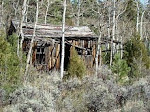
Leaving the Grand Canyon country, I headed west to Nevada in search for the elusive Big Horn Desert Sheep. Although, I have seen them in the past, I had never photographed them. It was a unique learning curve. Although smaller in body size of their cousins the Rocky Mountain Big Horn, their horns are the remarkable difference. I found them very reclusive and cautious in nature. The one exception to this is a city park in Boulder City, Nevada. In this area, the Bighorns will move down from the mountains surrounding the city park and bask on the lawns and the shade of the trees. A number of people have told me of this park, including my brother who also photographs wildlife. Arriving in the area after dark, I easily found the park overlooking Lake Mead. Throughout the night, I was treated to a lightening show and rain squalls. Siwashing out for the remainder of the night, I looked forward to daylight and seeing the sheep, the last sheep specie on my list. I was drinking my morning coffee when daylight gave me my first look of the park. It was a typical park consisting of swing sets, jungle gyms, and tennis courts. A good number of rabbits were enjoying the green grass, but no sheep. I waited for the heat of the day hoping that would be the key to trigger them to move into the park. A number of other visitors arrived and left, all telling me that the sheep are normally there. By 10:00 am, I decided to drive the neighborhood and see if I could spot sheep coming down from the mountains. The neighborhood was comprised of multiple hundred thousand dollar homes. To get to the park from the surrounding the hills, the sheep would need to walk the streets for five blocks to get into the park. I drove the shore road along the Lake Mead for several miles without seeing any sheep and returned to the park. The sheep had not moved into the park. I once again begin sitting and waiting. During my planning of the trip, I had planned on making a circle trip north of Las Vegas on one highway and return on a second route, as each areas had established herds of Big Horns. Finally deciding to give up the park for the present and make my circle route. My trip north was not productive, access into the area I wanted to visit was very limited. I spent the night in Tonapah, Nevada, about 150 miles north of Las Vegas. The following morning, I turned south to return to Las Vegas on Highway 95. There were two areas on this route that I had researched of which I wanted to visit. The first was out of Beatty, Nevada. Located just a few miles from the California border and Death Valley. Finding my access road, I headed into the mountainous country on a partially graveled and sand / dirt road. My entire time in this area, I did not see another car. The terrain was rocky with small mountains and indications of the early prospecting days in this area. In the area, less than an hour, I spotted my first two Bighorn Desert Rams traveling together. A lesson learned quickly, in their country, you are not going to see them unless they are moving. I also learned that you cannot catch up with a traveling ram. I got some good telephoto shots, then they topped the ridge and out of sight. I walked to the top of the ridge they were on and got one quick shot at them in some heavy brush. On my return trip to the truck, the concept of rattlesnake came to mind. My chasing days into the brush was over. I would see one other ram on this trip. While exploring the area, I found this miners cabin constructed of rock. When it was built, is not known but the area was littered with mining shafts that had been hand dug. It sat on a little flat top knoll with a good view of the valley, an ideal location to scout from. I returned to Beatty to refuel the Ford and get a few needed supplies. I would return to the area in the late afternoon for a evening hunt and to camp out for the night. Because of the location, I chose to park in the front yard of the miners cabin. If only it could talk, the stories it could tell of the past. Expecting to hear coyotes all night, all I heard was the occasional sound of a braying donkey. Dutch and I enjoyed a nice evening a cooking and preparing morning coffee. At daylight, we moved down the slope and onto the road, within minutes we found the braying donkey on the opposite side of the valley from where we camped. The wild donkey herd consisted of a dozen adults, with a definite leader. Possibly more aggressive as a leader than the stallions that I seen in the wild horse herds.
"My Base Camp"
These two pictures should be reversed in order, the high kick came after the following picture.

These were much larger and sleek donkeys in comparison to those that I saw in the Black Hills of South Dakota.

The herd topped over the ridge out of sight, but a secondary road followed the ridge, so I took it to see if I could get a few more shots of them, however they moved up a second valley and out of sight so I returned to sheep hunting.
Later in the morning, I spotted this ram sneaking through the rocks. I first saw him silhouetted against the skyline on the top of a ridge. I have seen them do this in the past, I am assuming it is attract other sheep and just perhaps a defensive move to look for predators.
On my way out, I did go back into the valley that I had followed the donkeys to see if could possibly get a chance to see them again. There were no donkeys on the slope of the ridge in which I was saw them, however, they were replaced by six Desert Bighorn Rams traveling together. What a great sight to see, like their counterparts, they gang up together, just prior to the rut. Then, they prove which one is dominant. "Gang Of Six"
Although, I like to get in close and personal when I take my pictures, using as little telephoto as possible to get the shot. I now knew, this was not going to happen when I am on their turf. They have the advantage. The only place this could happen would be in the park in Boulder City, but I decided, that I would much rather see them in this environment rather than standing ion front of a swing set. It was at this point that I decided not to return to the park.
Leaving the area happy, I sat out for my second location that I had researched out of Dyer, Nevada. It is located in a valley, bordered by the foothills of the Sierra Mountains and within walking distance to the California border. Two businesses in the community, a gas station / grocery store. The second is bar and restaurant across the highway. Friendly and helpful folks, primarily a farming and ranching community. Gathering a little local information about the sheep, I headed into the area that I had researched. There is also a half dozen wild horse herds in this area. The area I would explore is known as Mineral Ridge, where a major mining operation is underway.
Once again, I came across an old rock cabin except this one also used the terrain, to use as a back wall. This particular cabin was evidently a "line shack" or early ranch as corrals are also located close to the cabin. I am sure they came later, than when the cabin was built. The corrals are much older than the loading chute. Besides the construction being unique, note the roof has a wooden chimney and cactus growing out of the roof. I decided, this also would be my base camp for the night after scouting out the entire area. Names such as Tarantula Canyon, Rattlesnake Ridge, and Coyote Summit had me intrigued and cautious of where I placed my feet. In my exploration of the area, I did not see any sheep nor any other humans and returned to the cabin.
"Cabin Below The Cliff"
The following morning, I would see one Bighorn Ram. Watched him for sometime hoping that he would draw more to his location. Hating to, I decided that I still had a few miles to drive, that it was now time to head north and home.
Tonight, I am in Thompson River, Montana. My first stop on my way south. This is where I saw all of the Bighorn Ewes and lambs on my last visit. Hopefully, the five weeks that has elapsed, the Rams will be joining them. I will know come first light.

Saturday, October 16, 2010

On The Road Again

After spending a few days visiting my family in Montrose, Colorado, I am once again on the road. With four weeks on the road, the weather still holds for me, the rain squall that I saw in the Yellowstone is the only moisture that I have seen. Just sunny sky and warm to hot days.

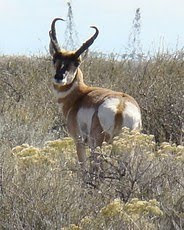
After leaving the Yellowstone, I crossed the wind swept prairies of south Wyoming, wind is putting it mildly. The only highway that I have ever seen that had aviation windsocks along the highway every ten miles or so. Inquiring as to why, I was told it was primarily for the truckers so they can judge the velocity and direction of the cross winds blowing across the highway. The number of Pronghorn antelope was countless.

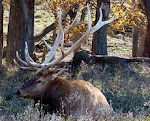
I entered Colorado a short distance from the entrance to Rocky Mountain National Park, remaining in Granby, Colorado for the night so I could enter the park at daylight. While I was safely tucked away in the Ford Motel, the park had it's first snowfall. Consequently, once again I could not drive through the park. Although it was just a dusting of snow in the park, the pass did receive a heavy snowfall and was closed. However, the ten miles that I was able to drive into, was well worth the trip. I was able to get up close and personal to a nice "royal bull elk that had a half dozen cows with him and one spike bull. The air was filled with the "sound of Bugling elk" including the big bull that I was photographing. I have several shots of him with his head back and calling out the challenge to other bulls.

This young bull was hanging with the "big guy" and his lady friends, however, when he got to close to the cows, the big bull would intervene and send him running.

"First Snow"

Taking out his frustrations on the nearest Ponderosa Pine tree. As with the the horned species, I have witnessed this trip he to was "scenting" his territory.

"Attacking the Tree"

"Victory"
"Watching Over His Ladies"
After spending, a few days visiting my family in southwest Colorado, I once again returned to the road on Friday, 10/15/2010. Driving south, I entered the San Juan Mountains in Ouray, Colorado. This trip would include attaining the highest elevation on my trip. At the summit of Red Mountain Pass, I was at an elevation of 11,018 feet. I have driven this route hundreds of times, in all seasons of the year, however, I had forgot how beautiful it truly was. The fall colors were at their prime. I have accidentally, downloaded these pictures out of order. This morning, I entered the canyon lands of Utah. There are Desert Big Horn sheep in this area, however, today was not my day to find them but the natural beauty of this area is well worth the trip. Exploring this vast area should be a mandatory place to visit on your vacation plans. It cannot be fully explored in less than a week. The area is so vast. To my surprise, there were more visitors in the areas that I visited today than I saw in Yellowstone or Mt. Rushmore combined. Although, my reliable GPS found me a spot where I did not see a person for twenty miles, I questioned her wisdom of taking me through the Sand Flats Road, but it was beautiful. "Window Rock" The fall colors are at their prime, this colorful hillside is Oak Brush recovering from a previous forest fire.
"Top Of the Pass" "The Castle" "Castle And Adjoining Rock Sculptures"
"1 of a 1,000 Rock Domes"
"San Juan Mountains ~ Red Mountain" "Base Of The San Juan Mountains ~ Ouray, Colorado"

Thursday, October 7, 2010

Turning South

After being on the road for three weeks, I am finally headed in southerly direction. Was planning on "siwashing" out tonight, but finally the rain caught up with me. After twenty one days, I finally had to turn on my windshield wipers. In the event anyone is wondering, when I shut the engine down this evening, I have driven a total of 7,270.6 miles. Tonight, I spend the night in Dubois, Wyoming. An area known for their Rocky Mountain Big Horn Sheep.
I left Cody, Wyoming this morning just as dawn was breaking. Each day, I seem to find something more beautiful and make intentions to return. Today, was no exception. Make a note, if you are going to explore Yellowstone National Park. Enter or exit the east entrance which is just 80 miles west of Cody, Wyoming. You will pass through the Big Horn Canyon and the valley of Shoshone River. The rock canyon and river valley is spectacular. It now has a special meaning to me, which you will discover why as you go through the posting.
Yellowstone N.P. is a gem stone in the crown of our National Parks. Been there so many times, but each time, I discover something new as it is ever changing. It was a disappointment to see that some of the magnificent Ponderosa Pine forest are not reduced to bare trunks and branches due to the Pine Bark Beetle infestation.
As a note to my wife, who usually travels with me. We messed up last year when we came out of Yellowstone and turned north to Jackson, Wyoming. We saw only a portion of the Grand Tetons from a distance. The spectacular display of mountains is south, we should have turned south to Dubois, Wyoming. However, due to the low cloud cover and rain, they were still spectacular.
There are several species on my "bucket list" that I have great concern about obtaining, however, today two of my concerns were taken care of. Some call it "lucky", I call it fortunate that I have been able to see and learn each day more about the species in which I am searching. I am "lucky" in the respect that I have the opportunity to achieve a goal.
Two of my concerns are as to how and where I was going to obtain photos of two species of the bear. The Black Bear and Grizzly Bear. Today, I was fortunate to obtain both and it was not in the Yellowstone. The many trips through there, we have never seen a bear, until today.
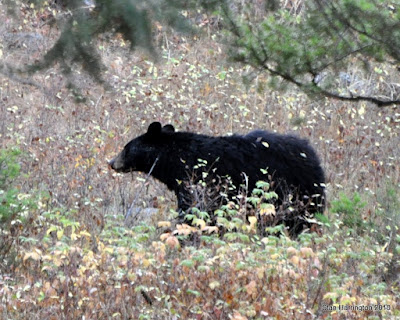
The first Black Bear came into view just a few miles from Cody, Wyoming in the area of Buffalo Bill State Park. He was a "Old Boar"and was moving through the prairie grass on the banks of the Shoshone River.

"Black Bear"

"Big Black Bear"

"Yellowstone National Park Northeast Landscape"

This little Black Bear found a nice rock in the sun in order to take a nap, every few minutes he would awaken and look around to see what was happening.

"Black Bear Napping In The Sun"

I have seen herds of Bull Elk, but this is the first Cow Elk that I have seen since leaving Montana. "Cow Elk ~ Yellowstone"

Most photographed bear in Yellowstone N.P. today, I spotted this little guy, appeared to be a yearling, maybe two year old. I had him to myself for twenty minutes, by the time I left, there was a road block with cars parked on both sides of the road. I have never seen so many cameras, some with lenses three feet long, bigger than the bear! Black Bear Feeding On Leaves ~ Yellowstone

These are the shots that made my day. I was still outside the Yellowstone and in the Shoshone River Valley, about twenty miles from where I saw the big Black Bear Boar. I was actually looking at the river, at what looked to be a good run to fish for trout. Then I saw a movement and some dust in the trees. Down the road a bit before I got stopped, backed up and there was "Mama Grizzly" and her cub. Next time you hear Governor Palin talk about the "Mama Grizzlies", this is what she looks like. She was busy digging up a pile of roots and branches for some reason, perhaps a stash of food that she had buried earlier. I was not going to investigate. Remembering, the Brown Bear at Hallo Bay, I sat down as not to represent a threat. Although, she watched me, she went about her business, but kept herself between me and the cub, unless he happened to take a peek around her shoulder. Not wanting to draw attention, each time I heard a car coming, I would put my camera down. No one stopped. I had her to myself for forty five minutes and finally she wandered off, with the cub out front. My day was complete and it had not even started.

"Mama Grizzly" There something about this pile of limbs and dirt that she is standing on and digging into. I think she is standing on that log, to show that is her territory, do not intrude any further.

"My Spot ~ My Cub ~ See My Claws"

"Also Did You See My Teeth"

"One Little Peek"

During my trip, I have seen Buffalo by the hundreds from the Yukon to Nebraska. Today, I would estimate that I saw 1,000 ~ 1,500 head of Buffalo in herds of a dozen to two dozen. The majority of them in the northeast corner. I ask a Park Ranger about them, this is their wintering area and they are just now moving into this area. The "buffie" population looks very good.

"It Was A Very Good Day"